


Every building we step into, every bridge we cross, every piece of infrastructure we rely on is made safer by standards. These technical documents guide engineers, architects, builders and regulators in designing and constructing a resilient built environment.
However, the system that funds Aotearoa’s standards is broken.
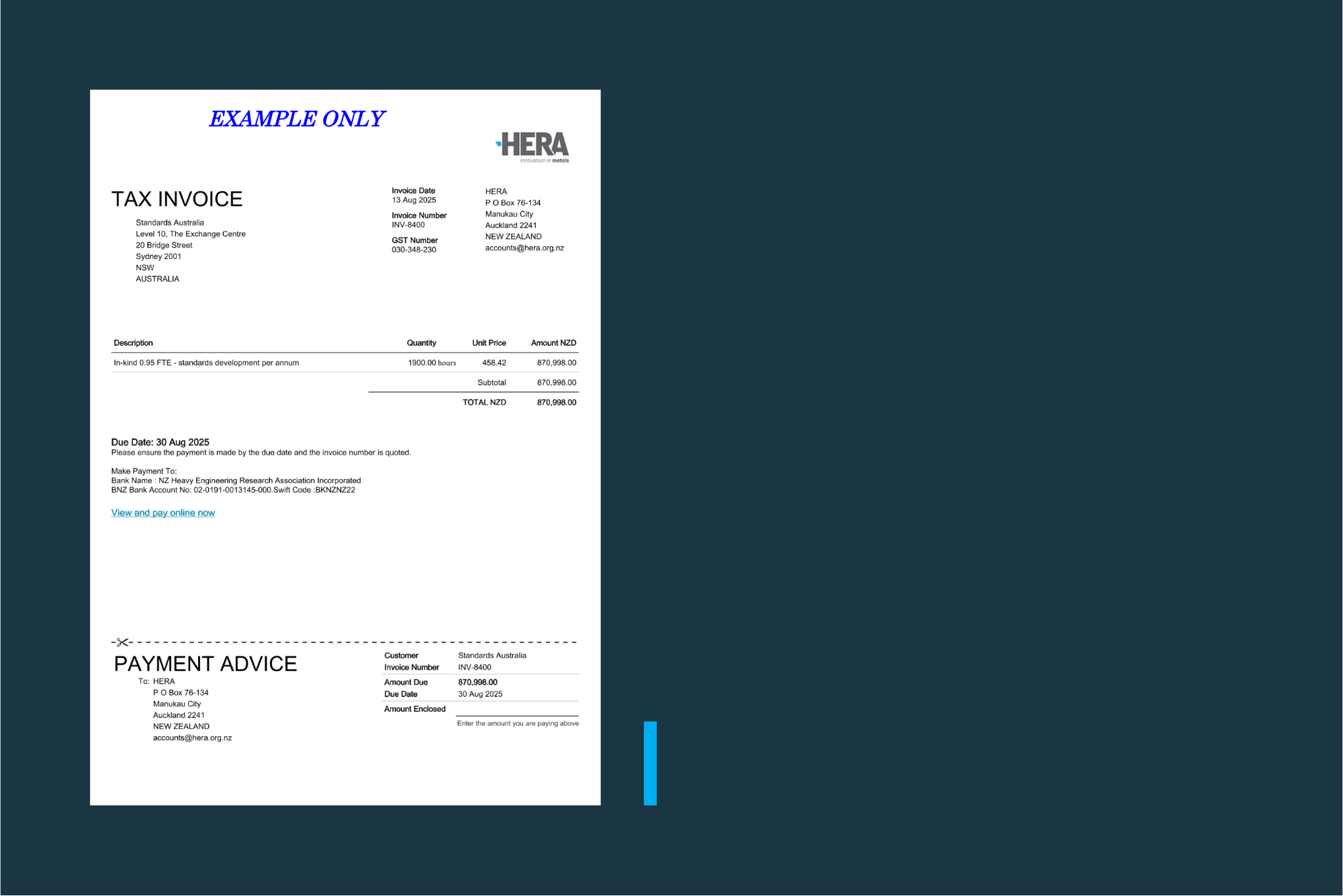
In the past year, HERA’s technical experts have contributed hundreds of hours to the development of essential AS/NZS and NZS construction and infrastructure standards. To give a sense of scale, if we charged their time at normal non-member consulting rates this would amount to $870,998. shows that industry is underwriting a very significant portion of Aotearoa New Zealand’s standards system.
Some of this work is underpinned by research funded through the Heavy Engineering Research Levy. On top of that, HERA provides experts to sit on committees, contributes to commissioning costs, and then pays again to access the final published standard. That’s four times at the till for the same piece of work.
No other part of our economy works this way. Imagine paying a third party every time you researched, wrote, printed, and then bought back your own textbook – that’s the reality our industry faces to keep standards up to date.
Standards aren’t paperwork. They safeguard lives, reduce risks from earthquakes, fires and high winds, enable innovation, and support sustainability and carbon-reduction goals. They don’t just “happen.” They rely on technical expertise, years of research, and the commitment of industry specialists. These are contributions that industry is carrying far more than its fair share of.
HERA is proud of the role we play in shaping standards. Our contributions span both committee participation (CP) -where our experts bring New Zealand’s voice to the table – and HERA-led research (R), which provides the evidence base that underpins robust, future-ready standards.
Our Contributions
Over the last 12 months, our experts have contributed to the following completed and in-progress standards:
Structural Standards
- NZS 3404: Steel Structures Standard (CP & R)
- NZS 1170.5: Structural design actions – Part 5: Earthquake actions – New Zealand (CP)
- AS/NZS 2327: Composite structures – Composite steel-concrete construction in buildings (CP & R)
- AS/NZS 1594: Hot-rolled steel flat products (CP)
- AS/NZS 5100.6: Bridge design – Part 6: Steel and composite construction (CP & R)
- AS/NZS 1170.0: Structural design actions – Part 0: General principles (CP)
- AS/NZS 1170.1: Structural design actions – Part 1: Permanent, imposed and other actions (CP)
- AS/NZS 1170.2: Structural design actions – Part 2: Wind actions (CP)
Welding and Materials Standards
- AS/NZS 1665: Welding of aluminium structures (CP)
- AS/NZS 2312.3: Guide to the protection of structural steel against atmospheric corrosion by the use of protective coatings – Part 3: Metal spray coatings (CP)
- AS/NZS ISO 14732: Welding personnel – Qualification testing of welding operators and weld setters for mechanized and automatic welding of metallic materials (CP)
- AS/NZS ISO 17633: Welding consumables – Tubular cored electrodes and rods for gas-shielded and non-gas shielded metal arc welding of stainless and heat-resisting steels – Classification (CP)
- AS/NZS ISO 18276: Welding consumables – Tubular cored electrodes for gas-shielded and non-gas-shielded metal arc welding of high strength steels – Classification (CP)
- AS/NZS ISO 636: Welding consumables – Rods, wires and deposits for tungsten inert gas welding of non-alloy and fine-grain steels – Classification (CP)
- AS 2205.8.2: Methods for destructive testing of welds in metal – Method 8.2: Transverse fillet shear test (CP)
- AS/NZS ISO 16834: Welding consumables – Wire electrodes, wires, rods and deposits for gas-shielded arc welding of high strength steels – Classification (CP)
- AS/NZS ISO 14343: Welding consumables – Wire electrodes, strip electrodes, wires and rods for arc welding of stainless and heat-resisting steels – Classification (CP)
- AS/NZS ISO 21952: Welding consumables – Wire electrodes, wires, rods and deposits for gas-shielded arc welding of creep-resisting steels – Classification (CP)
- AS/NZS ISO 15792.1: Welding consumables – Test methods, Part 1: Preparation of all-weld metal test pieces and specimens in steel, nickel and nickel alloys (CP)
- AS/NZS ISO 14344: Welding consumables – Procurement of filler materials and fluxes (CP)
- AS/NZS ISO 26304: Welding consumables – Solid wire electrodes, tubular cored electrodes and electrode-flux combinations for submerged arc welding of high strength steels – Classification (CP)
- AS/NZS ISO 15792.3: Welding consumables – Test methods, Part 3: Classification testing of positional capacity and root penetration of welding consumables in a fillet weld (CP)
- AS/NZS ISO 15792.2: Welding consumables – Test methods, Part 2: Preparation of single-run and two-run technique test pieces and specimens in steel (CP)
- AS/NZS 5557: Welding consumables – Covered electrodes – Determination of the efficiency, metal recovery and deposition coefficient (ISO 2401:2018, IDT) (CP)
- AS/NZS ISO 6848: Arc welding and cutting – Non-consumable tungsten electrodes – Classification (CP)
- AS/NZS ISO 17672: Brazing – Filler metals (CP)
In addition, we have supported the commissioning of a range of standards, such as:
AS/NZS 2312.3: Guide to the protection of structural steel against atmospheric corrosion by the use of protective coatings – Part 3: Metal spray coatings
This work safeguards our nation – but it is not sustainable to expect industry to keep footing the bill. If standards are critical to public safety, resilience and innovation, then their development must be treated as a public good. The current model, which relies heavily on voluntary industry contribution and then charges industry again for access, is no longer fit for purpose.
HERA will continue to contribute its expertise, research and evidence to ensure the standards that build Aotearoa New Zealand remain strong. But the question remains: why should industry pay four times for the same work that keeps the whole country safe?
It’s time for a stronger, fairer funding model – one that recognises standards as the public good they truly are.

