
How One Student is Bridging the Gap Between Workshop Floors and Digital Systems
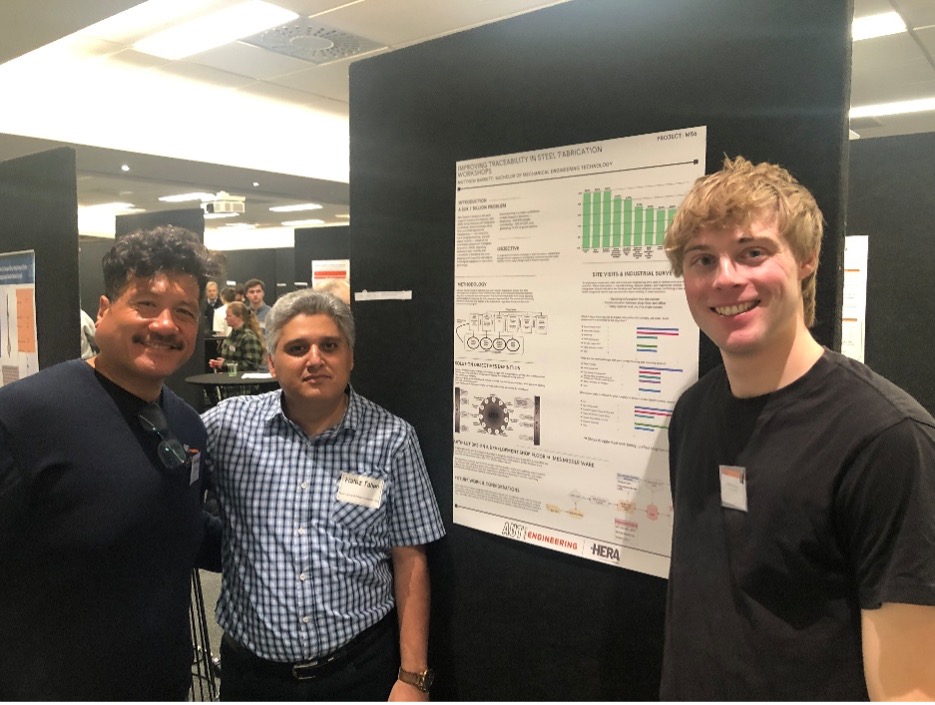
For his final-year engineering project, AUT student Matthew Barrett set out to answer a deceptively simple question: What if the markings, notes, and cues fabricators already use could be captured digitally without changing the way they work?
The idea was sparked a year earlier during an AUT scholarship programme that took Matthew through advanced manufacturing sites and research centres in India and Malaysia. What stood out to him wasn’t just the machinery, but the way everything was connected.
“I found it fascinating to see how physical work, planning decisions, quality checks, and digital records all flowed together as one process,” he says. “Seeing how those environments made industrial processes feel integrated and natural left a strong impression on me.”
Back in New Zealand, when an opportunity arose to explore similar ideas with HERA, he seized it. At first, he approached the project from a traditional angle of industrial traceability. But after spending time on workshop floors around Aotearoa and observing how coordination actually happens, the challenge crystallised into something more practical: digitise what already works.
Instead of creating new processes or asking fabricators to change their behaviour, Matthew asked: Can we translate chalk marks, traveller notes, inspection sign-offs, barcodes and QR scans directly into digital information and feed it to the planning software in real time?
Closing the Gap Between Reality and the System
In many steel workshops, work is tracked using traveller sheets, chalk or paint marks, and verbal updates. These methods are effective, but much of that information never reaches the MES (Manufacturing Execution System) or ERP software that planners depend on.
The result is a gap between what’s happening on the floor and what appears in the system, affecting traceability, scheduling accuracy, job visibility, and overall situational awareness.
This challenge reflects broader findings in New Zealand’s manufacturing sector. According to Callaghan Innovation’s Industry 4.0 work, most local firms are still early in their digital maturity not because of capability gaps, but due to the realities of small, resource-constrained operations. The research highlights that the greatest near-term gains don’t come from full automation, but from strengthening visibility and connectivity first.
Matthew’s project aligns directly with this need: enhancing digital visibility without changing how workshops operate.
A Lightweight Layer that Connects the Floor to the MES
To tackle the problem, Matthew spent time in multiple workshops, spoke with fabricators, ran surveys, and observed real workflows. From these insights, he developed a modular middleware system, a lightweight digital layer that sits between the shop floor and the MES.
The system captures identifiers and updates that already occur naturally such as heat and lot numbers written on steel, traveller sheet annotations, barcode or QR scans, and inspection sign-offs, and converts them into structured digital updates that sync directly into the MES.
It doesn’t replace existing tools or redesign workflows. Instead, it amplifies what workers are already doing, improving traceability and job visibility with minimal disruption.
HERA’s Crucial Support
Matthew credits HERA’s support as essential to the project’s success.
“They connected me with real workshops and provided the industry insight I wouldn’t have had otherwise,” he says. “That practical grounding made all the difference, it ensured the system addressed genuine needs rather than theoretical ones.”
What the Project Taught Him
Beyond technical development, the project reinforced a key lesson: technology must work with real-world constraints.
“It taught me the difference between academic ideals and the realities of workshop environments,” Matthew explains. “Workflows exist the way they do because they’re effective and digital tools have to respect that.”
He also gained hands-on experience with MES and ERP integration, traceability systems, and cross-platform data handling, skills he plans to carry into his career.
What Comes Next
Matthew intends to continue developing the middleware, both to strengthen its functionality and deepen his understanding of industrial systems. He sees opportunities to add support for more tools, including barcode scanners, RFID readers, and even computer vision models capable of recognising markings directly from steel surfaces.
His long-term goal is to make the system low-code and configurable, allowing workshops to tailor it to their own processes. Beyond this project, Matthew is eager to pursue a career at the intersection of manufacturing and digital systems.
The Potential Impact on Industry
While the system is still in early development, it offers a glimpse into how small, incremental digital steps could reshape New Zealand manufacturing.
Instead of large-scale overhauls, fabricators could digitise specific tasks where the benefits are immediate, building visibility and traceability one workflow at a time. It also provides a safe way to trial process improvements before committing to wider rollout. In a sector where resources are often limited, Matthew’s system demonstrates a practical pathway: start with what works and make it smarter.