


Examples of Best Practise in Welding Safety
The risk of fire and explosion is ever present with welding and thermal cutting and several recent fires caused by welding are a timely reminder of this. It is no coincidence that most welding equipment and welding consumables come with warnings either in the user instructions or on the packaging. Nor is it a coincidence that the first thing to be covered in any welding practical training is the basics of safety including the risk of fire and explosion.
To ensure that any weld is fit-for-purpose best practice is to carry out the work in accordance with a suitable standard or code. In NZ the most widely used standard is AS/NZS 1554.1 Structural Steel Welding. The objective of this Standard is to provide rules for the welding of a wide range of steel constructions and including repair and maintenance. While much of the Standard deals with technical requirements a basic principle is that all work must be carried out safely: Section 1.8.1 Safety equipment and procedures states “Welding shall be carried out in accordance with the relevant requirements of the following Standards: AS 1470, AS 1674.1, AS 1674.2, AS 2865, AS/NZS 1336, AS/NZS 1337, AS/NZS 1338.1”.
While the employer is primarily responsible for taking reasonable care of the health and safety at work of their employees, in the workshop or on-site the day-to-day responsibility for safety will usually fall on the person responsible for instructing and supervising welders: the welding supervisor. It is another principle of Standard AS/NZS 1554 that “Welding shall be carried out under the supervision of a welding supervisor employed by or contracted to the fabricator” (ref. Section 4.12.1).
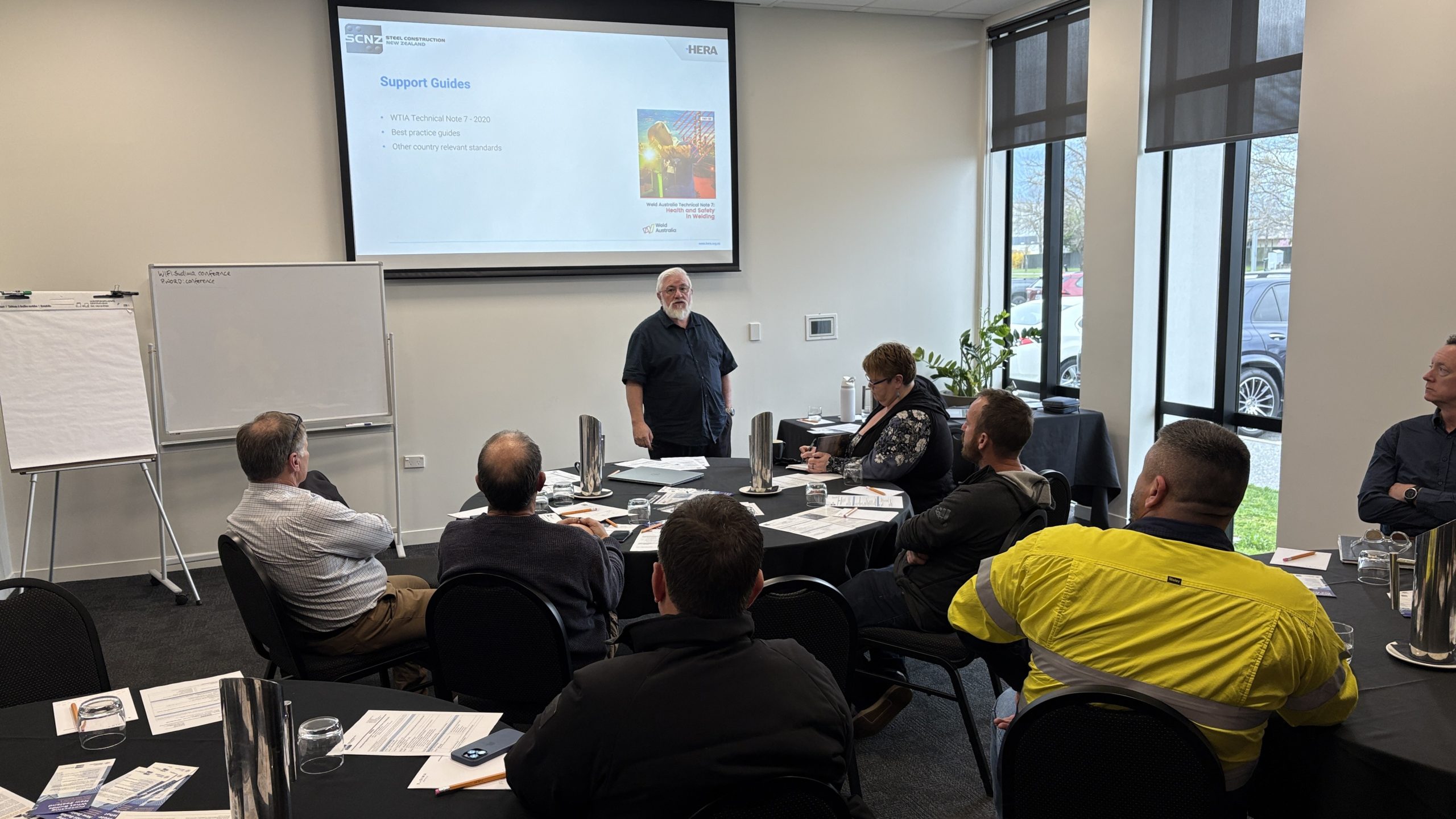
Worksites that involve work on high-risk plant such as tanks and piping, or confined spaces require “high level” risk management systems e.g. AS/NZS ISO 31000, AS/NZS 4801. While those who are supervising welding operations do not necessarily need to be experts on risk management systems, they need a broad understanding of welding and cutting related hazards, and most importantly they need know where to go for specialised knowledge and assistance. This information is readily available from a range of sources including guidelines and standards such as: • NZS 4781:1973 Code of Practice for Safety in Welding and Cutting • Hot Work on Drums & Tanks, Department of Labour (Worksafe) • Standard AS 1674.1-1997 Safety in Welding and Allied Processes – Fire Precautions • WTIA Technical Note 7 Health and Safety in Welding (also referenced in the NZQA units for welding). REF 10
In thermal cutting and welding the elimination of heat is not possible, therefore most strategies are based on elimination of fuel and oxygen while minimising the spread of heat. Therefore, close monitoring and supervision of welding activities are required to prevent incidents.
According to AS 1674.1, all hot work must have a hot work permit and be supervised by a person who is responsible for the safe execution of all operations. Hot work is defined as grinding, welding, thermal or oxygen cutting or heating, and other related heat-producing or spark-producing operations.
NZ 4781:1973 (section 6) and WTIA Technical Note 7 (section 16) provides the following indicative steps to reduce the potential for fire when welding and cutting:
- Before commencing welding and cutting the area shall be checked by both the employer of the welder (or representative) and a representative of the principle (company) to determine what hazards exit and what precautions need to be taken.
Note: If work is being conducted at an unfamiliar location, this is very important where there is a potential for overlapping duties under the Health and Safety in Work Act 2015
- Where practicable, remove the object to be welded or cut to a designated safe location away from any flammable materials
- If the object to be welded or cut cannot be removed, and before hot work is commenced in any location, the person shall ensure that the hazards of the location are identified, and appropriate safety measures put in place to minimise risks. This also includes testing to ensure that no flammable gas or vapour is present. Notes:
- Where practicable, a portable water hose reel shall be made available in the area where welding or cutting is performed
- Combustible floors shall be kept swept clean and shall be protected by means of spark resistant materials such as welding blankets, dry sand, wetting down the area or equivalent. If floors or surrounding areas are damp, provision shall be made to protect the welder from the hazards of electrical shock
- Any openings or cracks in the vicinity of welding or cutting must be sealed to avoid any spark encountering combustible materials. This includes cracks or holes in walls, floors, open doorways or windows
- The hazard may be on either side of the material to where the welding or cutting is being performed i.e. inside a vessel, pipe, through a wall, through a ceiling, lagging, insulation
- Suitable type of fire extinguishing equipment shall be readily available around the welding and cutting, and in a state of readiness for immediate use. All equipment shall:
- Be of appropriate size and type for the location the welding and cutting is being conducted
- Be “in test” with currency tags dated and any seals applied before use in place (if applicable)
- Fire watch person(s) shall be nominated, and the fire watch shall:
- Have the sole task of watching for ignition of flammable materials
- Not be interrupted with other duties or tasks until the standby period is finished
- Not use phone, tablet or any other device that may distract them from their task
- Be trained in the use of the fire extinguishing equipment provided
- Be physically capable of using the fire extinguishing equipment provided
- Maintain their role of fire watch for a minimum of 30 minutes following the completion of the welding and cutting. Note: a longer time may be required depending on the location of the work, potential for materials igniting, the location of flammable materials and/or any specific requirements on a hot work permit (if applicable)
- Note 1: Sparks can travel a great distance and appreciable combustible materials more than 10m from the welder and cutting can readily ignite
- Note 2: In some situations, more than one fire watcher may be required to monitor for fires and the same guidelines apply to all persons engaged.
If implemented properly, welding safety procedures will provide a sufficient safety margin to prevent welding-related accidents form occurring. The key to achieving this is adequate staff training in particularly at the level of the person supervising the welding. Training for those whose responsibilities include welding supervision and inspection is available through the HERA Training Centre. Health and safety in welding is a key topic covered in the Welding Supervisor course.

