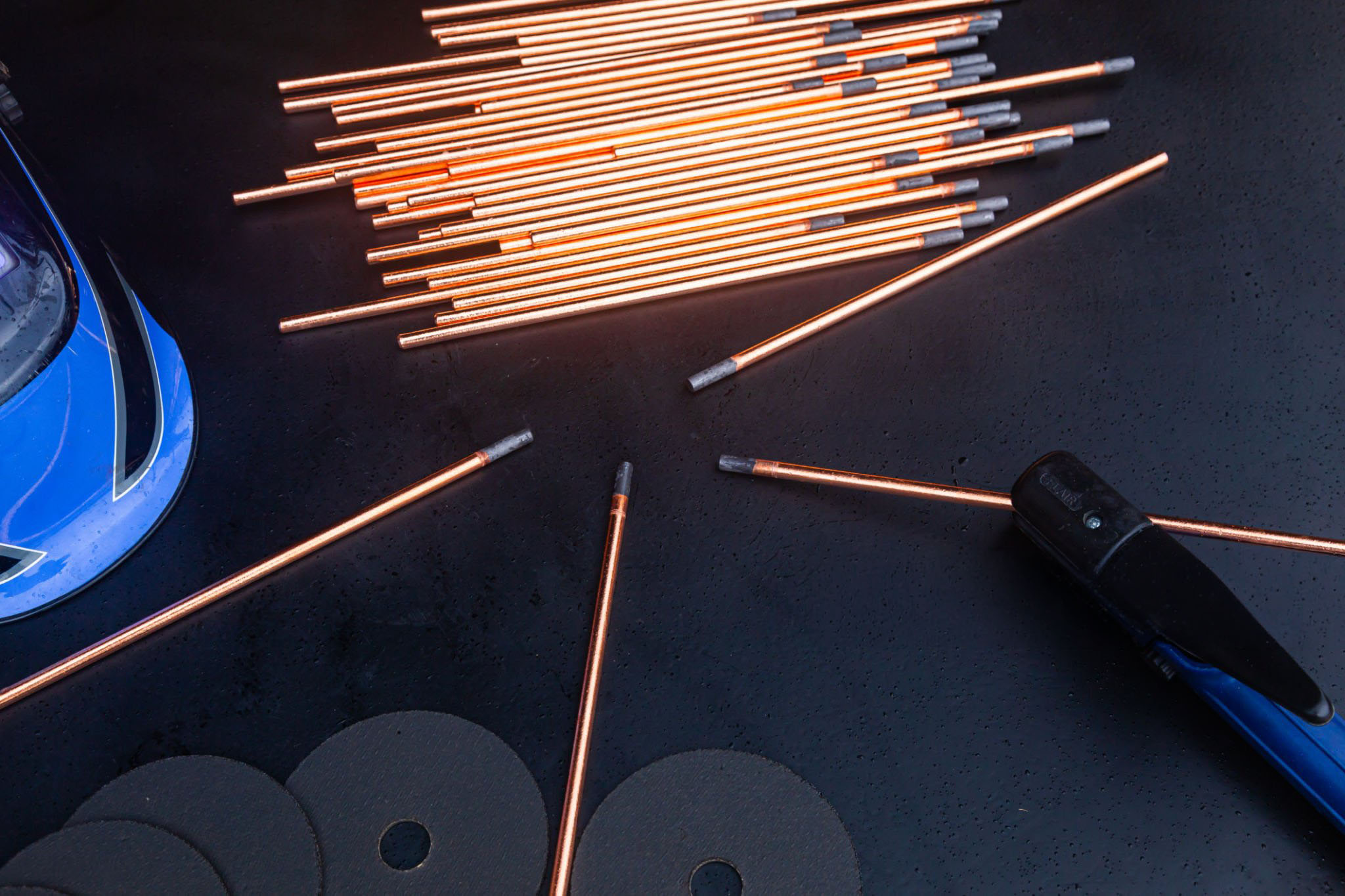
The manual metal Arc (MMA) welding process is commonly used throughout power plants, industrial sectors, railways, renewables and structural steel fabrication.
Due to its versatility, wide range of consumables available, relatively simple equipment requirements and good accessibility where space constraints exist, manual arc welding remains a reliable and relatively low-cost option.
Why Low-Hydrogen (LH) Electrodes?
For applications where superior mechanical properties and increased resistance to hydrogen cracking are required, Low Hydrogen (LH) electrodes are commonly preferred. Compared to other flux-coated electrodes, such as rutile and cellulosic electrodes, which have different flux characteristics, basic electrodes can deposit weld metal with controlled levels of diffusible hydrogen. Some electrodes are available with classifications such as H5 (5 ml/100 g) and H2 (2 ml/100 g), providing options for applications where hydrogen control is particularly important.
However, to achieve the intended weld metal quality and hydrogen content, these electrodes require the correct care, handling and storage procedures to be followed in accordance with the manufacturer’s recommendations.
Hydrogen-Induced Cracking (HIC)
The risk of hydrogen cracking increases when low-hydrogen electrodes are exposed to moisture or are not correctly controlled before or during use. When LH electrodes are supplied in unsealed packaging, moisture can be absorbed by the flux coating if the electrodes are not correctly stored or baked. This can increase the amount of diffusible hydrogen introduced into the weld.
Hydrogen cracking can occur when sufficient hydrogen is introduced into the weld and heat-affected zone (HAZ), particularly when combined with a susceptible microstructure and tensile stresses. During welding, hydrogen can enter the molten weld pool and subsequently diffuse into the weld metal and HAZ. As the weld cools, hydrogen can migrate to areas between grain boundaries and under certain conditions, this can contribute to hydrogen cracking.
Hydrogen cracking may be delayed and not immediately detected after welding and can develop several days after welding, depending on the material, hydrogen level, restraint and welding conditions. Therefore, where there is a recognised risk of hydrogen cracking, inspections should be delayed to mitigate the risk.
Mitigation of Hydrogen Induced Cracking (HIC)
As the carbon content increases, the risk of hydrogen cracking (HIC) rises significantly, requiring strictly to decrease the maximum allowable diffusible hydrogen in the electrode. High carbon promotes the formation of a hard and brittle martensitic microstructure in the heat affected zone (HAZ), contributing to the steel being highly sensitive to hydrogen embrittlement. Other factors such as carbon equivalent, material, cooling rate, heat input and the resulting microstructure need to be considered.
Preheating should be carried out as required by the welding procedure specification (WPS) to slow the cooling rate, allow for hydrogen diffusion, remove moisture from the surface of the steel and reduce the formation of hard brittle zones. Where hydrogen cracking susceptibility is high, the use of low-hydrogen electrodes with a suitable diffusible hydrogen classification, such as H5 or H2, may be required in combination with appropriate preheating and other controls. The selection of the electrode hydrogen classification should be based on the applicable welding standard, welding procedure and manufacturer’s recommendations.
Proper Care, handling and storage
The manufacturer’s recommendations for electrode baking should be strictly followed. An important consideration is the type of electrode packaging. Unsealed electrodes require baking before use. Hermetically sealed electrodes are supplied in airtight packaging that protects the electrodes from moisture until the seal is broken. A common misunderstanding is that the plastic wrapping around electrode boxes is considered sealed packaging. This is not correct.
For an electrode to be considered hermetically sealed, the packaging must provide an airtight seal as specified by the manufacturer. Therefore, careful consideration should be given when purchasing electrode packaging. The quantity required for site welding and the type of packaging supplied will determine how the electrodes should be handled. When a low volume of electrodes is required, it can be beneficial to purchase electrodes in smaller hermetically sealed packages. This can reduce the need to bake large quantities of electrodes before welding. Once the sealed package is opened, the manufacturer’s requirements for exposure time, rebaking and heated storage should be followed. When large volumes of electrodes are used during production, baking and controlled storage may be required for electrodes that have been exposed to the atmosphere. Electrodes should always be stored in a clean, dry and controlled environment to minimise moisture pickup. Once electrodes have been baked, they may need to be maintained at a controlled temperature in a holding oven or issued to welders in heated quivers or hot boxes, depending on the electrode manufacturer’s requirements and the applicable welding procedure. Electrodes should not be stored in ovens indefinitely. Where the permitted holding time or number of rebakes is unclear, the manufacturer should be consulted.
Prequalified consumables in relation to manufacturers recommendations
The manufacturer’s recommendations are important not only for electrode baking and storage, but also for the welding operating parameters. AS/NZS 1554.1 allows for the prequalification of welding procedures using specified consumables and applicable steel types. Where the prequalification provisions are used, the consumable and the applicable welding parameters as per the manufacturer fall within the requirements of the applicable standard.
The welding parameters recommended by the consumable manufacturer should therefore be considered when developing the WPS. Where welding parameters fall outside the applicable prequalification ranges, the welding procedure may need to be qualified by full testing in accordance with the applicable standard. This is particularly important because changing welding parameters can influence heat input, deposition characteristics, weld metal properties and hydrogen content.
Responsibilities of the RWC
Welding consumable control forms part of the welding quality related requirements covered by ISO 3834 and assessed under SFC certification. Welding coordination tasks and responsibilities are defined in BS EN ISO 14731:2019, which includes the control of welding consumables. It is therefore the responsibility of the Responsible Welding Coordinator (RWC) to ensure that appropriate procedures and controls for the selection, purchasing, identification, storage, handling and issue of welding consumables are established, implemented and maintained.
Key Takeaways
Proper care, handling and storage of LH electrodes are essential to maintaining the intended low-hydrogen characteristics of the consumable.
The following should always be considered:
- Use the correct electrode classification for the application.
- Keep electrodes dry and protected from moisture.
- Understand the difference between hermetically sealed and unsealed packaging.
- Maintain electrodes at the manufacturer’s specified baking and holding temperature where required.
- Follow the applicable WPS requirements for preheat temperature and welding parameters.
- Consider material susceptibility, carbon equivalent, thickness and hydrogen level when assessing hydrogen cracking risk.
- Where delayed hydrogen cracking is a concern, follow the applicable requirements for delayed inspection and NDT.
- The RWC must assign tasks and responsibilities for the control and handling of welding consumables in line with ISO 3834 requirements.
Proper care, handling and storage of LH electrodes are essential to ensure that the electrode’s flux coating can provide the required shielding, alloying elements, slag formation and deoxidising functions during welding, helping to maintain the intended mechanical properties and quality of the weld metal.