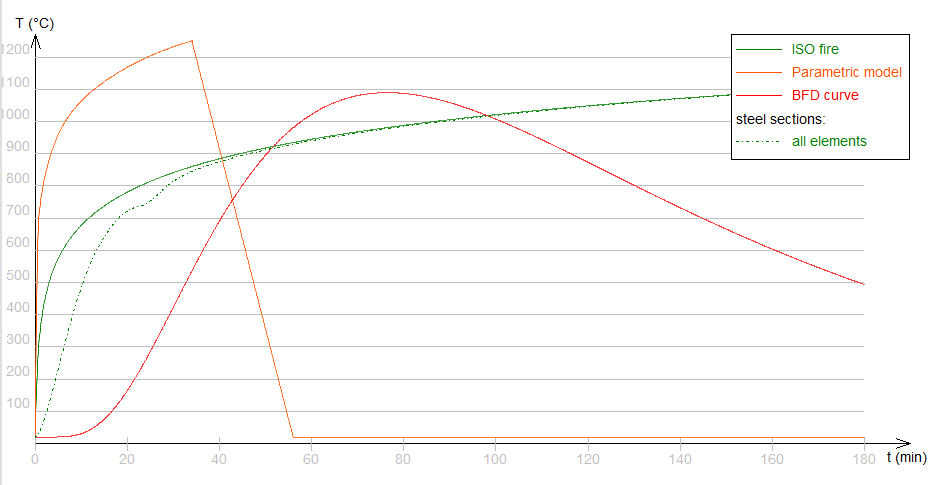
As engineers, we regularly assess how steel structures respond under fire conditions: building the design fire curve, running the heat transfer to get section temperatures, checking those against the critical temperature, sizing the protection system to close any gap. It’s core to the job.
Change One Input, Redo the Sequence
Change the compartment geometry or fuel load and the ventilation factor shifts, which can move a fire from ventilation-controlled to fuel-controlled and change the design fire curve altogether. Change the section factor (Hp/A) and the heating rate through to critical temperature changes with it. Change the protection thickness and you’re back into board or spray design tables, checking dry film thickness against a fire resistance rating that hasn’t moved.
Real projects don’t change one input at a time. Three protection systems across four compartment layouts. Bare steel against spray-applied protection and intumescent coating, checked against both a standard fire curve and a parametric fire. None of those calculations are difficult alone. Running twelve or twenty of them accurately, on a deadline, is where the time goes.
Same Inputs, Different Answer
We’ve seen projects where two engineers reach different results for the same member, because one is working to a different critical temperature assumption, a different section factor convention, or a different fire curve than the other.
Either approach can be defensible on its own. Put them side by side and a reviewer has to work out whether the gap is a genuine design difference or a difference in method or assumptions. That’s extra time on a design review that should have been straightforward, and extra time on verification before sign-off.
More Scenarios, Not Fewer
Performance-based fire engineering keeps asking for more of this, not less. A project that once checked a single standard fire curve now compares a range of design fires against multiple protection options, at multiple fire resistance ratings. This means less time spent building curves and running heat transfer calculations, and more time focused on engineering judgement, interpreting fire behaviour, and optimising the design solution.
These calculations are necessary. That was never the question.
The real question is whether there’s a better way to do them.
This was the challenge we set out to address.